Semi-Trailer Shipping & Delivery Guide
1. Choosing the Right Shipping Method: RORO, Break Bulk, or Container?
Selecting how your semi-trailer travels depends on vehicle specifications, budget, and local port unloading infrastructure.
- RORO (Roll-on/Roll-off):
The trailer is towed directly into an enclosed vessel deck via terminal tractors and secured with heavy-duty lashing chains.- Pros: Safest handling, zero crane lifting, fully sheltered from rain and salt spray.
- Best For: Turn-key fuel tankers equipped with delicate bottom-loading valves, vapor recovery manifolds, or optical sensors.
- Break Bulk (Bulk Carrier):
Trailers are hoisted into cargo holds or onto reinforced weather decks using port cranes. Units are often nested or stacked in tiered sets to optimize volume.- Pros: Highly competitive freight rates for multi-unit fleet orders; calls at smaller regional ports without RORO berths.
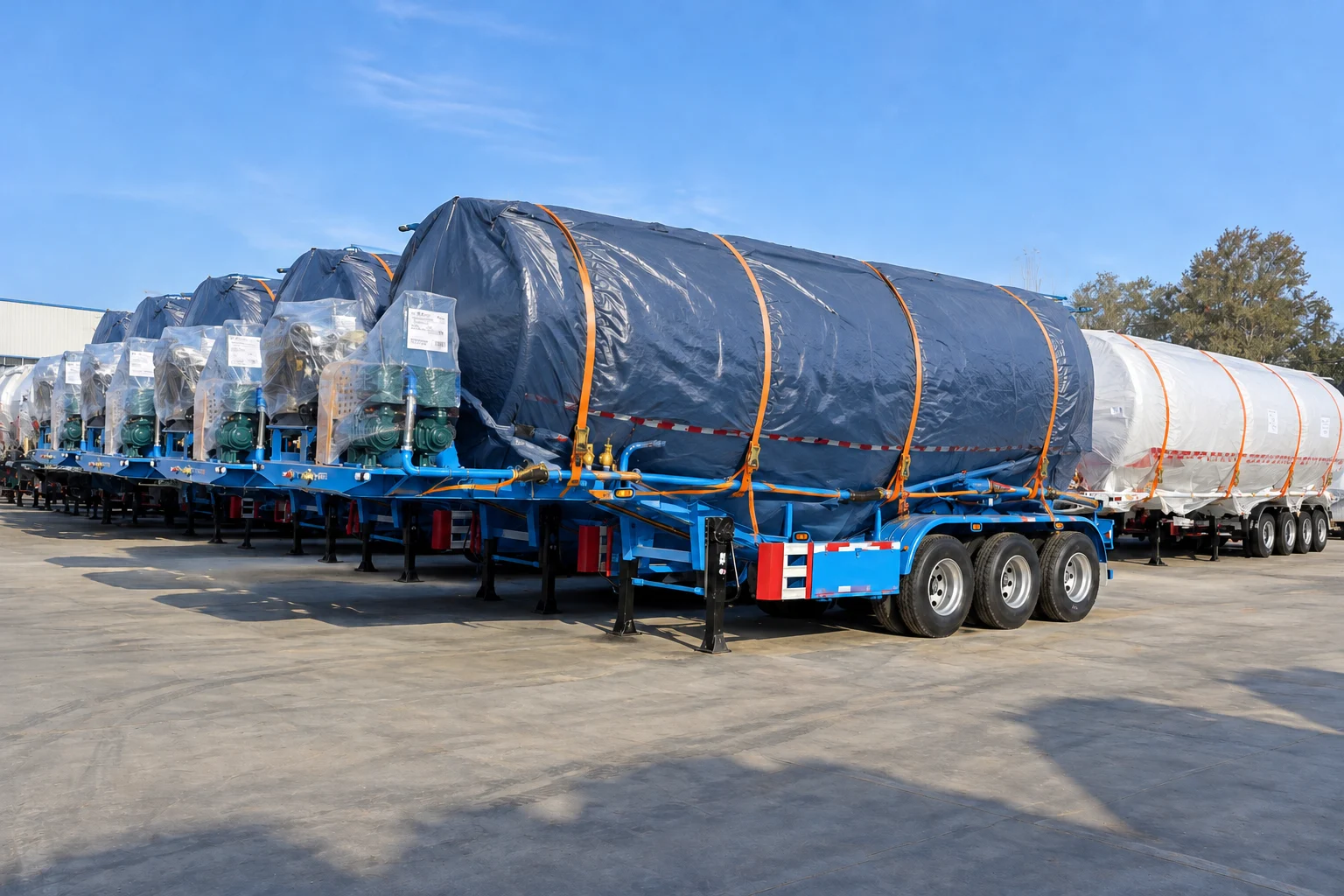
- Key Requirement: Request "Under Deck" stowage whenever possible. If shipped "On Deck", rigorous marine wax coating and heavy tarpaulin wrapping are mandatory.
- Containerized & Flat Rack (FR) Shipping:
For destinations with high bulk-shipping rates, trailers can be shipped via Flat Rack containers or disassembled for 40ft High Cube (40HQ) containers. Modular trailers feature detachable running gear, suspensions, and landing legs.- Best For: Importers with equipped local workshops and overhead hoists capable of reassembling running gear according to manufacturer torque specifications.
2. Anti-Corrosion Protection: Guarding Against High Salt & Humidity
A transoceanic voyage typically exposes cargo to 20 to 45 days of intense equatorial moisture and airborne salt mist. Professional preservation measures are essential before loading:
- Full-Body Marine Wax Spraying: The entire chassis, tank shell, landing gear, and axle assemblies should be thoroughly coated with specialized marine anti-rust wax. This creates an impermeable barrier against salt-spray oxidation and easily washes off at the destination using warm water and industrial detergent.
- Sealing Pneumatic & Electrical Circuits: WABCO relay valves, ABS sensors, glad hand air couplings, and lighting junction boxes must be shrink-wrapped with waterproof plastic and industrial tape to keep out sea salt and abrasive dust.
- Valve & Manhole Shielding: Discharge valves, vapor lines, and manhole seals must be tightly closed, locked, and covered with heavy-duty PVC protective sleeves.
- Suspension & Tires: Airbag suspensions should be mechanically pinned in transport mode, and exposed tires shielded from UV and ozone degradation.
3. Estimated Transit Times & Port Dwell Planning
Transit schedules fluctuate based on carrier routing, transshipment hubs, and port congestion. Practical benchmarks include:
- Southeast Asia: 7 – 15 days
- Middle East & Red Sea: 15 – 25 days
- East Africa (Mombasa / Dar es Salaam): 22 – 32 days
- West Africa (Lagos / Tema / Luanda): 35 – 50 days
- South America: 35 – 48 days
Important Importer Advice: Factor in port clearance dwell time (often 3–7 days). Always instruct your logistics agent or supplier to request 14 to 21 Free Demurrage Days (Detention & Demurrage Free Time) from the shipping line prior to departure to avoid costly terminal penalty fees.
4. Documentation Essentials for Smooth Customs Clearance
Document discrepancies are the primary cause of clearance delays and storage penalties. Ensure all vehicle identification numbers (VIN), engine/chassis ratings, and cargo weights match across all papers:
- Bill of Lading (B/L): Clean on-board ocean bill of lading stating accurate consignee, notify party, and VIN list.
- Commercial Invoice & Packing List (CI/PL): Complete breakdown of dimensions, unladen weight, compartment capacity, and CIF/FOB values.
- Certificate of Origin (CO): Standard CO or preferential trade certificates (e.g., Form E) for import tariff concessions.
- Mandatory National Conformity Certificates: Specific import compliance documents, such as PVOC (Kenya), SONCAP (Nigeria), SASO/SABER (Saudi Arabia), or third-party SGS/BV inspection certificates where required.
- Tank Hydrostatic Pressure Test Report: Proves leak-free shell integrity for hazardous liquid or pressurized dry bulk transport.
5. Destination Port Receiving & Commissioning Checklist
Before signing the port Equipment Interchange Receipt (EIR) and driving out of the port gate, follow this 4-step inspection:
- Exterior Visual Inspection: Check the tank shell, kingpin plate, side guards, and rear bumper for transit scratches, dents, or chain rub marks. Photograph any damage immediately while the trailer is still inside the terminal.
- Valve & Manhole Check: Confirm that fuel discharge valves, internal emergency foot valves, or powder fluidizing aeration valves remain intact, closed, and undamaged.
- Accessories Inventory: Verify all items listed on the packing list—spare tires, 6m discharge hoses, fire extinguisher brackets, grounding reels, and landing gear crank handles inside the toolbox.
- Pre-Service Commissioning:
- Wash off all exterior protective wax.
- Re-torque all wheel hub nuts and suspension U-bolts to specified ratings (typically 550–650 Nm).
- Connect tractor air lines and perform a 5-minute soap-bubble air leak test across all pneumatic valves and chambers before entering highway service.
- Best For: Importers with equipped local workshops and overhead hoists capable of reassembling running gear according to manufacturer torque specifications.