
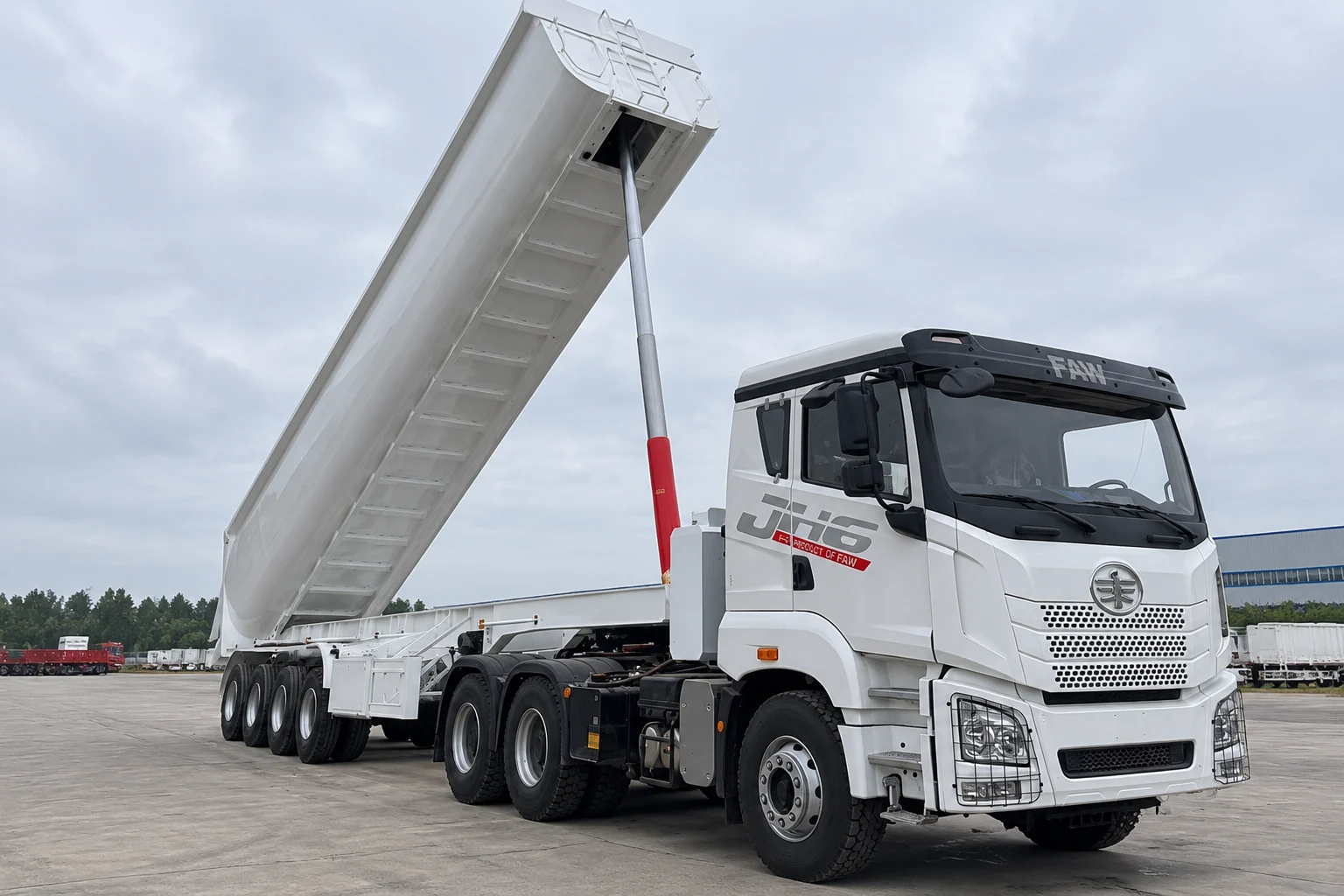
Preventing Dump Trailer Rollovers on Soft Ground: Center of Gravity, Chassis Flex, and Cylinder Choice
For quarry operators, earthmoving contractors, and mining fleets, a rear-tipping semi-trailer rollover is the ultimate operating nightmare.
It happens in seconds: the telescopic cylinder reaches full extension—pushing the dump body eight to ten meters high. Suddenly, one side's dual tires sink into soft fill. The elevated center of gravity shifts outside the wheel track, gravity takes over, and thirty to forty tons of steel and rock slam onto their side. The hydraulic hoist snaps, the tractor chassis twists, and repair bills easily run into tens of thousands of dollars.
Rollovers on uneven ground are rarely pure driver error. In most cases, they stem from an engineered mismatch between chassis torsional rigidity, hoist geometry, and body shape.
Understanding these mechanical forces allows fleet managers to specify tippers engineered to resist lateral tipping.
1. U-Shape (Half-Pipe) vs. Rectangular Box: Material Hang-Up Physics
A primary trigger for tip-overs isn't just ground softness—it is eccentric payload discharge.
When hauling wet clay, sticky bauxite, or moist overburden, cargo packs tight into the 90-degree corners of traditional rectangular boxes. If material breaks loose cleanly on one side while clinging to the other, the load becomes dangerously unbalanced. At full hoist extension, that asymmetric weight creates an overwhelming lateral overturning moment.
●Why U-Shapes Perform Better: The rounded bottom eliminates internal right-angle corners. Material funnels naturally down the center axis during initial lift stages.
●Faster Discharge at Lower Tilt Angles: A rounded floor allows sticky material to slide out at lower tilt angles (often 5 to 8 degrees earlier in the lift cycle than a square box, depending on moisture). Less time spent at maximum elevation directly reduces rollover exposure.
●Lower Center of Gravity: U-type bodies built from high-yield, wear-resistant steel eliminate heavy external side ribs. This lowers tare weight and drops the unladen center of gravity closer to the chassis rails.
2. Subframe Torsional Rigidity: Rear Pivot Geometry
When a dump body rests in the travel position, the body itself stiffens the entire trailer. But the moment the hoist pushes the body upward, that structural bond disappears. The subframe must resist all ground-twisting forces on its own.
On soft or sloping ground, a flexible chassis twists under load, tilting the upper body even further toward the low side.
Critical chassis specs to resist twist:
●Wide Rear Pivot Spacing: The rear hinge shaft is the fulcrum keeping the tipping body aligned with the axles. Heavy-duty specs widen the distance between rear hinge brackets as far as practical toward the spring centers, dramatically increasing the stabilizing moment against lateral roll.
●Box-Section Rear Torsion Tubes: Standard open C-channel crossmembers buckle under twisting loads. Severe-duty trailers utilize a large-diameter seamless tube or fully closed box-section crossmember directly anchoring the rear hinge brackets.
●Suspension Roll Stiffness: Avoid soft, tall-ride suspension setups on tippers. Heavy-duty mechanical multi-leaf suspensions with wide spring centers, or heavy-duty single-point bogie systems, limit lateral axle articulation while tipping on soft pads.
3. Telescopic Cylinder Selection: Column Strength and Side Loads
A multi-stage hydraulic cylinder is a lifting device, not a structural crane boom. It is designed to push straight along its longitudinal axis and possesses almost zero structural resistance to lateral side loads.
●Front-Mounted (Outer Head) Cylinders: Always specify front-end telescopic cylinders (mounted outside the front bulkhead) over underbody hoists for long tippers. Front placement maximizes lifting leverage, requiring lower system operating pressure and creating a stable triangular lifting plane.
●Cylinder Deflection at Stroke End: At 8 to 10 meters of stroke, multi-stage sleeves flex slightly. Premium hoists utilize precision-machined, hard-chromed cylinder tubes with tight internal guide tolerances to minimize sleeve play.
●Spherical Trunnion Mounts: Top and bottom cylinder mounting points should utilize spherical bearings. If the chassis flexes slightly on uncompacted ground, spherical mounts allow controlled self-alignment without binding the cylinder rods.
4. Job-Site Ground Rules for Fleet Operators
Even the most robustly engineered tipper cannot defy the laws of physics if operated recklessly. Enforce three non-negotiable site rules:
⑴Verify Lateral Level Before Hoisting: Operators should never initiate tipping on a lateral slope exceeding the builder's rated safety limit (typically anything over roughly 3 to 5 degrees is hazardous; consult your operator manual).
⑵Equalize Dual Tire Pressures: A tire running significantly below its partner on the same hub flexes like a soft sponge. When thirty tons lift into the air, that low tire compresses, tilting the rear axle by several inches.
⑶Never Pull Forward While Fully Raised: If sticky material hangs up, pulling forward with the body at full height transfers massive shock loads through the rear hinge pins, triggering an immediate dynamic rollover.
Engineering Your Tippers for Tough Ground
A rollover doesn't just destroy equipment—it can halt entire mining concessions or infrastructure contracts. If your fleet operates on soft spoil tips, riverbeds, or unpaved haul roads, specifying high-yield U-bodies, wide-track rear pivot assemblies, and front-mounted telescopic cylinders is the only way to safeguard your drivers and your bottom line.