
How Quality Semi-Trailers Are Built: High-Strength Steel, Submerged Arc Welding & Shot Blasting
Most buyers never see the inside of the plant that makes their trailers. They see an export yard, three coats of fresh paint, and a quotation with a list of axle brands they recognise.
If you want to know what that trailer will look like after four rainy seasons on corrugated haul roads, none of those things will tell you. You have to look at what happened in the welding bay and the blast booth before the primer went on.
Here is what that work looks like on our floor.
Why mild steel belongs in history books
Walk through any scrap yard near a freight terminal and you will see the same pattern: trailer chassis that cracked across the lower flange, or bent permanently under an overload that was barely ten per cent above rating.
Nine times out of ten, those chassis were built from Q235 or similar low-carbon commercial steel. Q235 has a yield point around 235 MPa. It is cheap, easy to bend, and forgiving when a welder makes a mistake. But to get enough beam stiffness out of it, the builder has to use 10 mm or 12 mm plate. That means dead weight. Every trip the truck makes, the tractor is burning diesel just to drag that extra steel along, and the owner loses that weight in legal payload.
We build our main beams from T700 high-strength low-alloy steel. Its yield strength starts at 700 MPa, roughly three times higher than mild steel. That strength lets us run thinner web plates and engineered flange thicknesses without sacrificing load capacity. The trailer comes off the line lighter, but because the steel resists deformation under dynamic bounce, it does not fatigue the way a thick, soft mild-steel beam does.
There is a catch with T700, though: you cannot weld it like mild steel. If you overheat it, you destroy the grain structure in the heat-affected zone. If you cut it with a dull shear, you leave micro-tears on the edge that turn into cracks later. That is why every heat number on incoming plate is checked against the mill test report before the plate touches a CNC cutting bed.
The main beam: one seam, no pauses
The main longitudinal beam is the backbone of any semi-trailer. If the beam fails, the trailer is salvage.
When buyers tell us about a broken beam on an older unit, the break almost always happened near a weld joint between the web and the lower flange. And almost always, the root cause was a restart point.
When a human welder runs a seam by hand with a stick or a MIG gun, he can only weld forty or fifty centimetres before he has to stop, reposition his body, chip slag, and strike a new arc. On a 13-metre beam, that means twenty to thirty stops and starts per side. Every single restart is a potential defect: a tiny crater, a void where the gas pocket didn't escape, or a spot where the new bead didn't fully penetrate the old one. Under cyclic road vibration, that crater is where a crack begins.
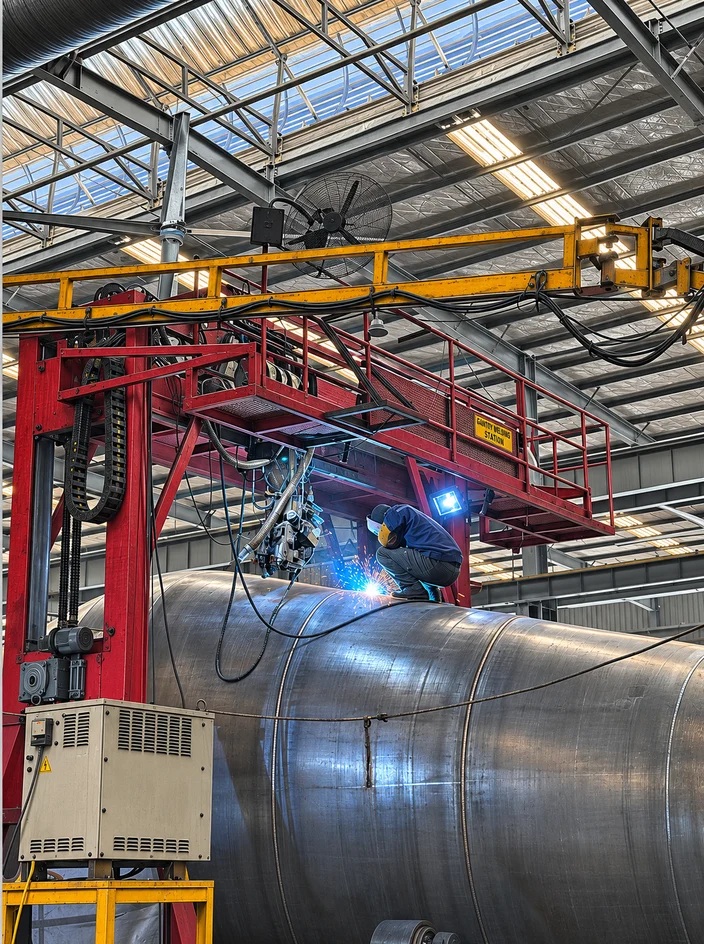
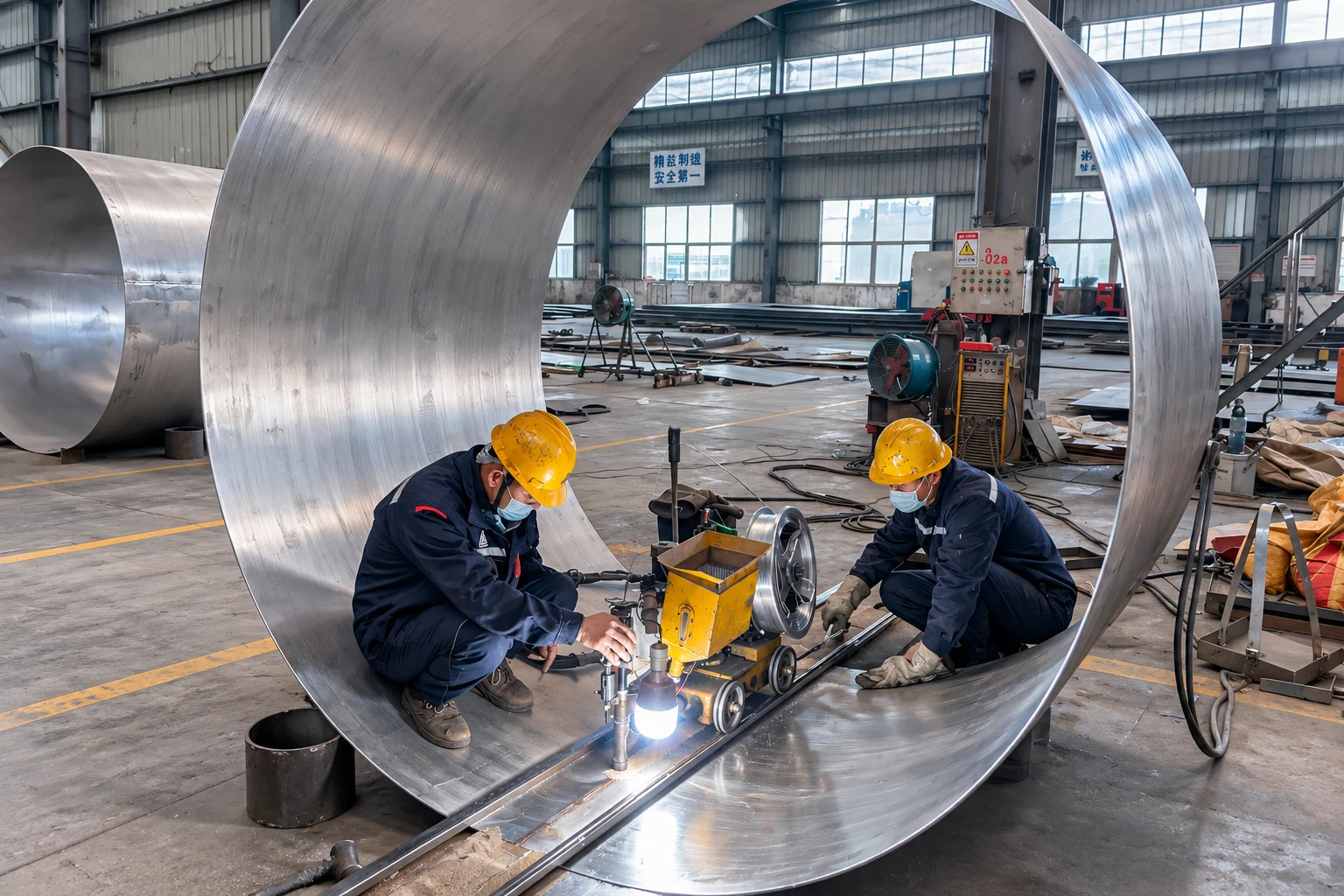
On our main-beam line, we use custom submerged arc welding gantries. The beam is locked into a rigid hydraulic clamping jig that holds the web and flanges square under thousands of kilograms of pressure. The welding head travels down the 13-metre seam in a single, uninterrupted pass at a controlled speed and current, completely buried under granular flux.
Because the arc is shielded from the air, there is zero porosity, deep penetration into the root of the joint, and zero spatter on the surrounding plate. Most importantly, there are no restart points between the front bolster and the rear bumper. The flange and web become a single metallurgical piece.
After cooling, every critical section passes ultrasonic non-destructive testing to verify internal fusion before the chassis moves to the next station.
Why paint fails from the inside out
If you have ever seen paint peeling off a trailer chassis in large, stiff sheets, you were looking at mill scale failure, not paint failure.
Hot-rolled steel leaves the steel mill with an iron oxide crust called mill scale. It looks smooth and grey, and if you spray paint directly over it, the trailer looks fine when it rolls out of the factory gate. But mill scale is brittle and has a different thermal expansion rate than the steel underneath. After a year of sun, rain, and chassis flex, moisture creeps through micro-cracks in the paint, gets between the scale and the raw steel, and oxidises. The scale pops off, taking the paint with it. At that point, repainting is useless unless you grind it down to bare metal.
Our chassis go through a fully enclosed automatic shot blasting room before any paint touches them. High-velocity steel grit hits every square centimetre of the welded structure from multiple angles, stripping away 100% of the mill scale, rust, and weld oxidation down to an Sa2.5 near-white metal standard.
Just as critical as cleanliness is the anchor pattern. The grit leaves a rough surface profile between 40 and 70 microns deep. That profile gives the primer a mechanical grip, like microscopic teeth holding the coating.
Within hours of blasting, before any surface flash rust can form in ambient humidity, the chassis enters the spray booth. We apply a multi-layer protective coating system:
- A zinc-rich primer applied directly to the blasted steel. The zinc particles provide active galvanic protection; even if gravel chips through the paint on a dirt road, the zinc sacrifices itself to stop rust from creeping beneath the film.
- An epoxy intermediate barrier coat that seals the surface against chemical attack and moisture penetration.
- A two-component aliphatic polyurethane topcoat, catalysed at the gun, which provides high gloss retention, abrasion resistance, and UV stability against sun fading.
The total dry film thickness (DFT) is measured with magnetic gauges across dozens of points on the chassis and logged in the production record before delivery.
Ask to see the welding bay
Any trading company can send you a PDF brochure with glossy pictures of a finished trailer parked in the sunshine. Glossy paint can hide Q235 steel, manual piecemeal welds, and mill scale that will rust through in two seasons.
When you evaluate a semi-trailer manufacturer, ask for three things:
- A mill test certificate matching the heat number stamped on the main beam plates.
- A video of the submerged arc gantry running the actual flange-to-web seam on your chassis.
- A dry film thickness inspection sheet showing the blasted surface profile and coating micron readings.
If a factory can show you those three records without hesitation, you know you are buying equipment engineered for the long haul.